

Quickstart
Create an API key, send a chat completion through the chokepoint, and find the record it left behind.
1. Create an API key
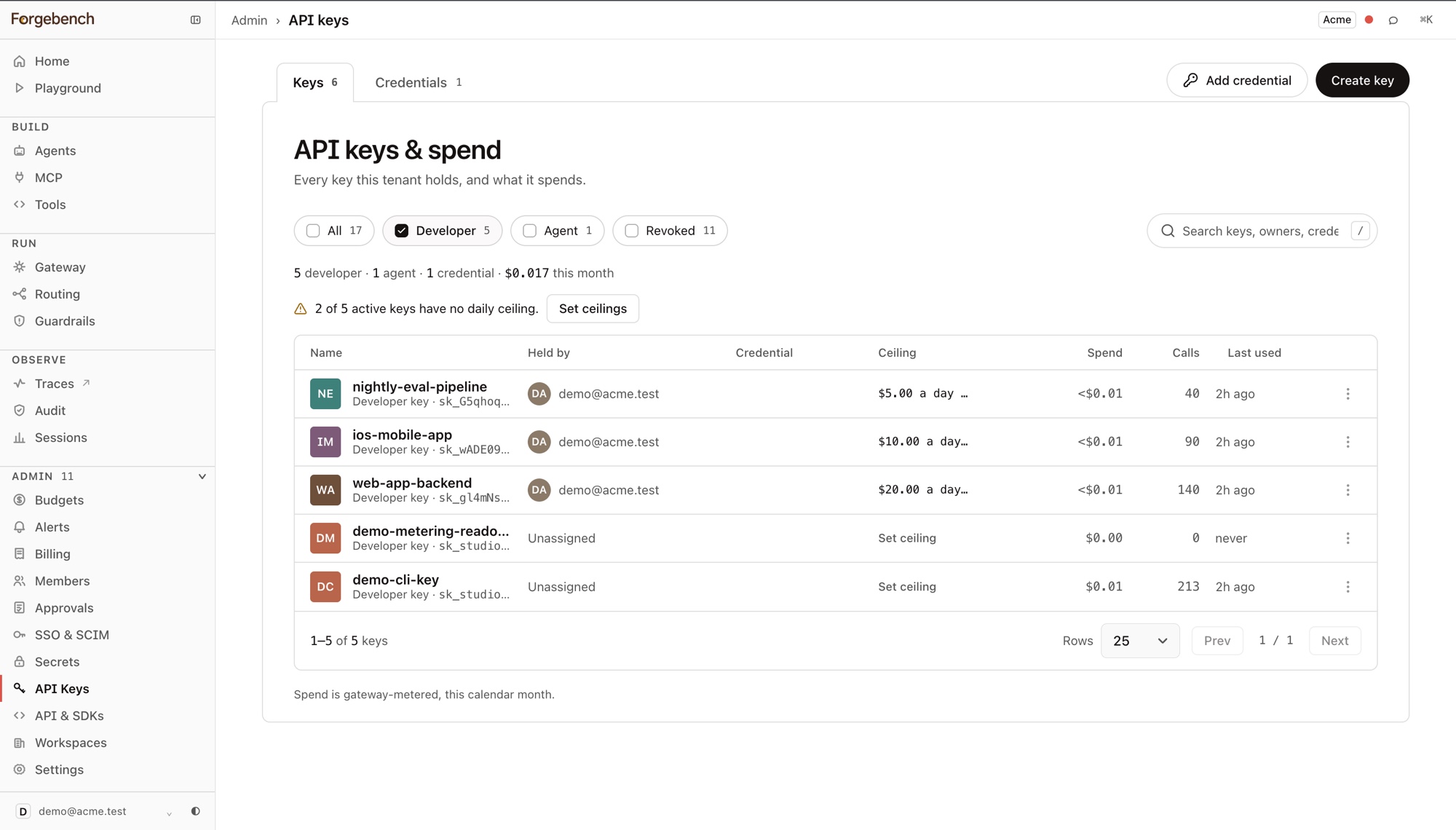
Each key carries its own scopes, model allowlist and daily/monthly spend caps.
Open API Keys
In the sidebar, expand Admin and choose API Keys.
Add a provider key first, if you have not
Developer keys hang off a provider credential (your OpenAI, Anthropic or Gemini key), which Forgebench stores encrypted and injects at call time. Your code never holds the provider key, so revoking it is one action here rather than a redeploy.
Mint a developer key
Give it a name, set a daily and monthly cap, and tick the models it may reach. Both caps and the model list stay editable afterwards.
Copy the secret now
The
sk_...secret is shown once, at creation. Forgebench stores only a hash of it, so it cannot be shown again later.
2. Install an SDK
pip install "git+https://github.com/seedlinglabs/forgebench-sdk.git#subdirectory=sdk-py"npm install "github:seedlinglabs/forgebench-sdk#path:/sdk-ts"3. Send the call
Point the client at your workspace's API URL and pass the key. mock-gpt is a
built-in test model that costs almost nothing, use it to prove the path works
before you spend real provider money.
from forgebench import Forgebench

# api_key defaults to $FORGEBENCH_API_KEY, base_url to $FORGEBENCH_BASE_URL
client = Forgebench(api_key="sk_...", base_url="https://api.forgebench.ai")

resp = client.chat.completions.create(
  model="mock-gpt",
  messages=[{"role": "user", "content": "Prove the governed path works."}],
)

print(resp.choices[0].message.content)
print(resp.usage.total_tokens)
import { Forgebench } from "@seedlinglabs/forgebench-sdk";
const forgebench = new Forgebench({
baseUrl: "https://api.forgebench.ai",
apiKey: process.env.FORGEBENCH_API_KEY!,
});
const res = await forgebench.chat.create({
model: "mock-gpt",
messages: [{ role: "user", content: "Prove the governed path works." }],
});
console.log(res.choices[0]?.message.content);
console.log("tokens:", res.usage.total_tokens);curl -X POST https://api.forgebench.ai/v1/chat/completions \
-H "Authorization: Bearer sk_..." \
-H "Content-Type: application/json" \
-d '{
"model": "mock-gpt",
"messages": [{"role": "user", "content": "Prove the governed path works."}]
}'4. Read the response
The shape is OpenAI-compatible, so existing code mostly works unchanged, with one addition:
{
  "id": "chatcmpl-a5a25bcd-3632-4b60-9964-a0828565cdbc",
  "object": "chat.completion",
  "created": 1789101061,
  "model": "mock-gpt",
  "choices": [
    {
      "index": 0,
      "message": { "role": "assistant", "content": "Hello from the Forgebench mock model …" },
      "finish_reason": "stop"
    }
  ],
  "usage": { "prompt_tokens": 10, "completion_tokens": 20, "total_tokens": 30 },
  "trace_id": "600902b2bd484291b7433f10ac4465f1"
}
trace_id is the addition, and it is the thread to pull on. It ties this
response to its audit entry, its metering record and its trace, so "what did the
agent do at 14:32" has a single answer you can look up rather than reconstruct.
5. Find the record it left
That one call wrote to several places at once. Each is a different question:
What happened, span by span, with latency and token counts.
AuditThe tamper-evident record that it happened, and who caused it.
BudgetsWhat it cost, and what remains under the cap.
What happens when it is refused
Budgets are checked before the call is forwarded, so a refused call costs nothing: it never reaches the provider.
Over the cap, the chokepoint returns 402:
{
  "detail": {
    "code": "budget_exceeded",
    "message": "monthly budget exceeded",
    "limit_usd": "0.000100",
    "spent_usd": "0.000385",
    "attempted_cost_usd": "0.005000"
  }
}
The body tells you the cap, the spend against it, and what this call would have
cost, enough to decide whether to raise the cap or fix the caller. The Python
SDK raises this as BudgetExceededError.
Troubleshooting
| You see | Cause |
|---|---|
401 unknown api key | The key is wrong, was rotated, or was revoked. Mint or rotate one on API Keys. |
402 budget_exceeded | Working as intended. The cap was reached. Raise it on Budgets, or wait for the window to roll over. |
403 on a call that used to work | The key's scopes or model allowlist do not cover what you asked for. Check them in the key's Manage dialog. |